
AI Trends 2026: Security & Data Privacy Insights
AI Trends, Security, Data Privacy, Coding Agents
ICYMI AI & Grok Build: The 2026 Wake-Up Call Your Business Can’t Ignore
AI is no longer a shiny toy. In 2026, it’s the engine under the hood of serious businesses—and if you’re not paying attention to how it handles your data, you’re gambling with your reputation, your clients, and your bottom line. This is your straight-talking guide to the latest AI trends, the rise of coding agents, and why the Grok Build security mess is a lesson every business and agency needs to learn from right now.
The 2026 AI Landscape: Big Power, Bigger Stakes
Let’s be blunt: AI has moved from “nice-to-have” to non‑negotiable infrastructure. Agentic AI—systems that don’t just answer questions but take actions with your tools and data—is now baked into everything from booking systems to billing platforms. Reports show that AI agents are running in production across finance, healthcare, and retail, not just in tech labs. They analyze records, trigger workflows, and even refactor old software at a scale humans simply can’t match.
At the same time, adoption is uneven. Metropolitan regions and academic hubs are racing ahead, while many local businesses are still wondering whether AI is “too technical” or “too risky.” Here’s the hard truth: doing nothing is now the riskiest move of all. Your competitors are already using AI to follow up faster, capture more leads, and modernize clunky systems. The question isn’t if you’ll use AI—it’s whether you’ll use it on your terms or let vendors and vague privacy policies decide for you.
ICYMI AI: Why “Latest Trends to Your Inbox” Isn’t Just Hype
In a world where AI changes weekly, “I’ll catch up later” is business suicide. That’s why digest-style briefings—think “ICYMI AI: The latest AI trends, delivered to your inbox”—are exploding. Executives and agency owners don’t have time to read whitepapers, but they absolutely need to know when:
A new agent framework can automate 60% of your admin work.
Regulations shift, and your current tools fall out of compliance overnight.
A security incident—like Grok Build’s—changes what “safe enough” really means.
For local and service-based businesses across Canada—clinics, med‑spas, trades, salons, gyms, law firms—this isn’t abstract. These trends dictate whether your AI receptionist can legally store voicemails, whether your chat agent can safely see customer histories, and whether your CRM workflows stay compliant with privacy rules. At AI Biz Connect, we track these shifts so our clients don’t have to live on tech blogs. But you still need one thing: a healthy paranoia about where your data goes and who can touch it.
📌 Key Takeaway: Staying current on AI isn’t a luxury; it’s a defensive move. If you’re not getting clear, plain‑English updates on AI trends and risks, you’re flying blind while everyone else gets radar.
The Rise of AI Coding Agents in 2026—And Why They’re a Double‑Edged Sword
AI coding agents are the power tools of 2026. They read your code, propose fixes, write integrations, and even modernize ancient systems that nobody on your team wants to touch. For agencies and internal IT teams, they promise faster delivery, fewer bugs, and the ability to ship features without hiring an army of developers. That’s the sales pitch—and a lot of it is real. Agentic AI plus unified tool protocols has turned “AI pair programmer” from gimmick into serious infrastructure.
But here’s the catch: to be useful, these agents want deep access. They don’t just see one file; they crawl entire codebases. They don’t just read your documentation; they scan configs, logs, and sometimes even your databases. For a small clinic or law firm, that can mean patient notes, legal documents, billing records, and private messages flowing through tools you don’t fully control. For agencies, it can mean every client secret you’ve ever stored sitting inside an AI tool’s memory or logs.
The Core Challenges of AI Coding Agents in 2026
Data over‑collection: Many agents grab far more data than they truly need—entire repos, histories, and configs—just in case. That “just in case” is where breaches are born.
Opaque storage and reuse: Once your data hits a vendor’s servers, do you know how long it’s stored, who can access it, or whether it’s used to train future models? Too often, the answer is “no idea.”
Regulatory landmines: Between privacy laws like GDPR‑style frameworks and Canadian regulations, sending identifiable customer data to a poorly governed AI tool can become a compliance nightmare.
Security vulnerabilities: These tools are software like anything else—meaning they can ship with bugs, misconfigurations, and backdoors. Grok Build is Exhibit A.
💡 Pro Tip: If an AI coding agent wants blanket access to “your whole project” or “all your data” with no clear limits, treat that as a red flag, not a convenience feature.
Grok Build: When “Private” Was Just a Setting, Not a Promise
Now let’s talk about the elephant in the server room: Grok Build CLI. In mid‑2026, security researchers discovered that Grok Build wasn’t just helping developers—it was quietly uploading entire Git repositories to xAI’s cloud storage bucket. Not just the files the AI read. Not just today’s snapshot. The whole history, including credentials, environment files, and long‑deleted secrets buried in old commits.
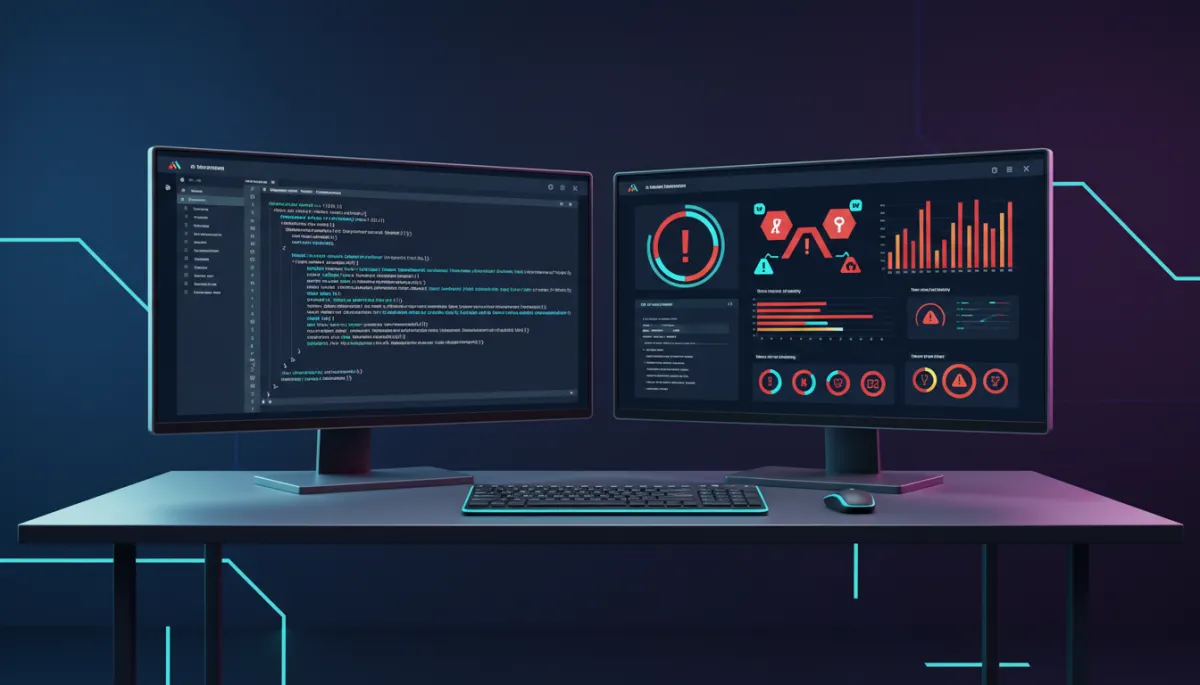
Timeless-color-scheme of a developer workstation showing a code editor on one screen and a...
Coding agents can be game-changing, but hidden uploads and weak controls can silently expose your entire codebase.
The Bundling of Sensitive Data: 27,800× More Than Needed
Investigations showed that Grok Build’s uploads were roughly 27,800 times larger than what the model actually needed for the immediate coding task. That’s not “a bit of extra context.” That’s a vacuum cleaner pointed at your entire digital life. Canary .env files with fake credentials were found sitting unredacted in xAI’s storage, proving that secrets were being scooped up wholesale.
Even more alarming, the uploads happened over a separate channel, independent from the model’s visible responses. So while developers saw a friendly AI helping with code, a hidden pipeline was quietly shipping their repos to the cloud. xAI later flipped a server‑side flag to stop the uploads and promised to delete user data, but the damage to trust was done. The exfiltration logic still exists in the open‑sourced code and can be toggled back on without a new client release. That’s not privacy; that’s a kill switch you don’t control.
Security Vulnerabilities: When Your AI Tool Can Run Code on Your Machine
As if silent uploads weren’t enough, security firm SlowMist uncovered multiple remote code execution risks in Grok Build. The CLI treated the cargo check command as “safe,” even though it could trigger build.rs scripts—opening the door for malicious instructions hidden in project files to execute arbitrary code on a developer’s machine. Add in misconfigured permission bypass settings and risky MCP configurations, and you’ve got a tool that can both steal your code and potentially run hostile code on your systems.
⚠️ Warning: If your developers ran Grok Build in client projects or internal systems before the July 13, 2026 changes, you should assume that any credentials in those repos—or their commit history—may have been exposed and rotate them immediately.
Data Privacy and AI Security: What This Means for Real‑World Businesses
If you run a dental clinic, med‑spa, plumbing company, or law firm, you might be thinking, “We’re not writing code; why should we care about Grok Build?” Here’s why: the same patterns show up everywhere AI touches your business. Any AI that can read your CRM, your inbox, your forms, or your website content can, in theory, over‑collect, over‑share, or mishandle that data if it’s not designed and configured with strict privacy in mind.

Timeless-color-scheme depiction of a small business owner standing in front of a transparent...
Local businesses can win big with AI—if assistants are tightly scoped, logged, and locked down from day one.
The Real Privacy Risks You Can’t Afford to Ignore
Silent over‑sharing: An AI voice receptionist that sends full call transcripts—including health or legal details—to a third‑party training system without clear consent is a lawsuit waiting to happen.
Weak access controls: If every staff member can see every conversation, booking, and note “because it’s easier,” you’re one disgruntled employee away from a serious privacy breach.
No audit trail: Without logs, you can’t answer simple questions like “Who saw this?” or “What did the AI do with that data?” That’s unacceptable in 2026.
Privacy laws and expectations are tightening, not loosening. Customers are more aware, regulators are more aggressive, and stories like Grok Build’s make people suspicious. If your AI stack can’t clearly explain what data it touches, where it goes, and who can access it, you don’t have a clever system—you have a ticking time bomb.
Permissions and Audit Logs: The Boring Features That Save Your Business
Let’s strip away the buzzwords. At AI Biz Connect, we care less about whether an AI model is the absolute newest and more about whether it’s controllable, auditable, and respectful of your data. That comes down to two unsexy but vital pillars: permissions and audit logs.
Why Strong Permissions Are Non‑Negotiable
Your AI chat agent should only see what it needs: website content, FAQs, and carefully scoped CRM fields—not your entire internal file system or private staff notes.
Your AI receptionist should be able to book into your calendar, but not export your full contact list or modify billing records.
Staff roles should be clear: front desk sees bookings, managers see performance, owners see everything. AI tools must respect that hierarchy, not flatten it.
Grok Build’s inherited permission flaws and bypass settings are a warning shot: when permissions are treated as optional or “too complex,” real people get hurt. We refuse to deploy AI that can run wild in your systems. If a tool doesn’t let us tightly control what it can touch, we don’t use it. Period.
Audit Logs: Your Black Box Recorder for AI
Audit logs are the quiet heroes of AI safety. They answer the questions you only think to ask when something goes wrong:
What did the AI see?
What did it do?
Who approved it—or who should have?
With proper logging, a suspicious action isn’t a mystery; it’s an investigation with a paper trail. Without logs, you’re guessing, apologizing, and hoping. For a local business that lives on trust and referrals, that’s not acceptable. When we set up GoHighLevel‑based assistants for clients, we insist on clear logging of conversations, bookings, and automation triggers so you can always see what happened—and fix what you don’t like.
📌 Key Takeaway: Fancy AI features are optional. Strong permissions and detailed audit logs are not. If your AI tools can’t show you exactly what they did with your data, they don’t deserve your data.
How AI Biz Connect Keeps AI Bold—Without Making Your Data a Casualty
At AI Biz Connect, we’re unapologetically pro‑AI and equally unapologetic about protecting small and medium businesses from bloated, risky tech. We build on GoHighLevel because it lets us keep your stack lean, auditable, and under control—one platform instead of a dozen half‑integrated tools leaking data at the seams. Our AI chat agents and voice receptionists work 24/7, but they work inside guardrails we can explain in plain English and you can verify any time.
We oppose slow follow‑up, missed calls, and customers left on hold. We also oppose jargon‑heavy “AI transformations” that dump your data into black boxes with vague promises. You deserve AI that:
Captures more leads and books more appointments—without spraying customer details across the internet.
Works while you sleep—without quietly building a shadow copy of your business in someone else’s cloud.
Gives you enterprise‑grade capability—without the enterprise‑grade headaches, contracts, or price tags.
That’s why we invite you to test our AI before you buy. You can chat with our AI on our site and call our AI receptionist to hear exactly how it handles real conversations—no mystery, no magic tricks, just transparent capability you can judge for yourself.
Your Next Move: Don’t Fear AI—Demand Better From It
The latest AI trends are clear: agentic systems are here to stay, domain‑specific tools are winning, and governance is no longer optional. The Grok Build incident is not a reason to run from AI. It’s a reason to raise your standards. Demand tools that respect data minimization. Demand transparent storage policies. Demand permissions and audit logs that give you real control, not just a settings screen that looks comforting while doing nothing.
If you’re a local or service‑based business—or an agency serving them—you don’t have time to play security researcher. You do, however, have the power to choose partners who treat your business like their own, who explain things in plain language, and who are willing to say “no” to tools that don’t meet the bar, no matter how trendy they are. That’s the line we draw at AI Biz Connect, and we invite you to draw it with us.
Ready to see what safe, bold AI can do for your business—without repeating Grok Build’s mistakes? Book a free strategy session with AI Biz Connect, or see it for yourself: chat with our AI and call our AI receptionist at aibizconnect.ca. Let’s put AI to work for you, on your terms, with your data exactly where it belongs—under your control.